
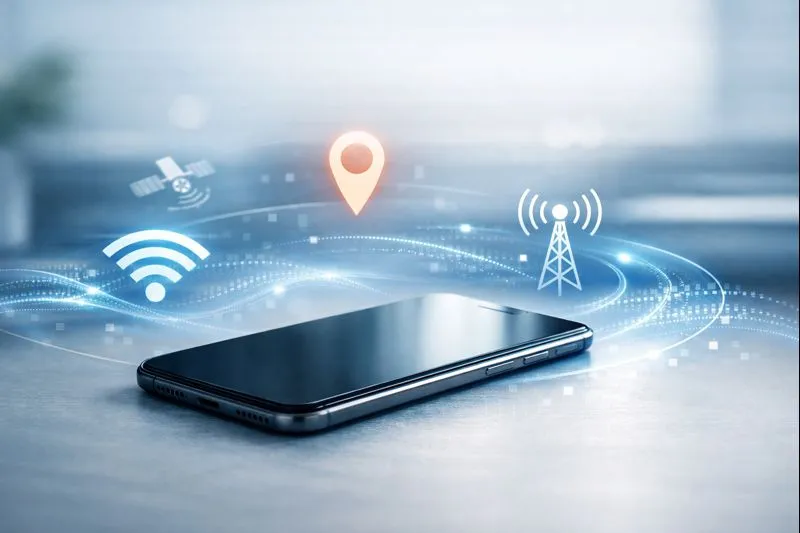
Introduction: How harmless is the technology in your pocket?
Today, smartphones are an integral part of our lives. Communication, work, entertainment, banking—everything is now limited to a small device. But the question is, is this smartphone just our assistant, or is there some technology hidden inside it that is collecting a huge amount of information every day without our knowledge?
Many people think that privacy is guaranteed if you turn off your phone. In reality, it is not that simple. Modern smartphones, network systems, and data collection technology have been developed in such a way that it is technically possible—and in many cases, it is done.
In this article, we will try to understand, not in the light of emotion or panic, but in the light of information and technological reality
How smartphones, networks, and digital infrastructure are able to monitor our movements, why this surveillance has been created, and why it is important for us as ordinary users to be aware.
This article is based on publicly available technical research, historical records, and widely accepted digital privacy practices.
Surveillance is not new: from the telegraph to the smartphone
The concept of digital surveillance is not at all modern. Its roots extend back to the 19th century.
People understood that it was possible to intercept electrical signals wherever they were going. Messages were intercepted in military and commercial communications from that time on. Knowing war tactics or business information in advance was a great advantage.
The development of radio and satellite technology in the 20th century expanded this issue further. The fact that information sent via radio waves can be received by someone else gradually became clear.
A historical event is noteworthy here. At the beginning of the 20th century, an experiment by the pioneer of radio communication, Guglielmo Marconi, proved that third-party interference proved that radio signals are never completely secure. This event is considered the beginning of modern cybersecurity thinking.
Mobile networks: the tower tells you where you are
Today’s mobile phone is basically a radio device. It communicates with nearby cellular towers all the time.
As you move, your phone connects from one tower to another. Using this information, it is possible to determine your approximate location through trigonometric calculations. In urban areas, this accuracy can be within about 100–300 meters.
This is not a secret technology—it is necessary for network management. This data is used for everything from reducing call drops to providing faster internet. However, by analyzing the same data, a clear idea of the user’s movements can be created.
GPS: You are not the only one who knows your location
GPS, or Global Positioning System, was originally developed for military purposes. It was opened to the general public in the 1990s.
Today, your phone’s GPS chip can accurately receive signals from satellites, so you know exactly where you are. This information is used not only by the Maps app but also by many other apps.
The important thing is—
- How long will you stay where you are
- How fast are you walking
- Where do you regularly go
By analyzing all this information, it is possible to get an idea about your daily routine. It is also used for legitimate purposes such as advertising, traffic analysis, and urban planning—but can also pose privacy risks if misused.
Voice assistants and sensors: always “listening” technology
Voice assistants like Google Assistant, Siri, or Alexa are always ready to listen for specific words. Technically, they are activated to detect “wake words.”
The companies claim that the entire conversation is not recorded. However, studies have shown that incorrect detection can often result in the collection of irrelevant audio clips.
The main question here is—
How do we know where information is going?
The need for privacy laws, data policies, and user controls has arisen to answer this question.
State surveillance: security vs. privacy
Many countries have long been conducting communications surveillance under the pretext of national security. The activities of agencies such as the US NSA have been discussed in various international reports.
Whether the purpose of this surveillance is to prevent terrorism or national security, there is a global debate about mass surveillance. The European Union’s GDPR or other data protection laws were created for this reason—to protect citizens’ rights.
Bluetooth, Wi-Fi and IoT: The Invisible Network All Around
Bluetooth, smartwatches, smart TVs, smart meters—all together we are now living in the Internet of Things (IoT) era.
These devices provide convenience, but at the same time:
- Device presence can be detected
- Usage patterns can be understood
- Intrusion is possible if security is weak
This is why the military and research institutions are strict about the use of personal smart devices.
Covid-19 and digital tracking: A real example
During the pandemic, many countries have used mobile data to protect public health. Movement analysis, understanding the speed of infection spread, and all of which were technologically possible.
This proves that technology itself is not good or bad. Use and control are the key.
So what should ordinary users do?
There is no need to be afraid, but it is important to be aware.
Understand app permissions
Turn off unnecessary location and microphone access
Read the privacy policy at least once
Keep software updates regular
These small habits can greatly increase your digital security.
Conclusion: Technology is for us, not us for technology
Smartphones and modern digital technology have made our lives easier and faster than ever before. Whether it’s communication, education, healthcare, or business, there’s no denying the contribution of this technology. However, it’s also true that in exchange for these conveniences, our personal information has become a valuable asset. How this information is being collected, where it’s being used, and who controls it are more important than ever.
The purpose of this article is not to create fear but to highlight the reality. Technology itself is never good or bad; its use determines its impact. As conscious users, it is our responsibility to be aware of our information, take necessary precautions, and be aware of protecting digital freedom.
Awareness, transparency, and responsible use—these three are the cornerstones of a safe digital life in the future.
Disclaimer
This article is published for informational and educational purposes only. The technologies, examples, and analysis mentioned here are presented based on common sense and open data. It is not a conspiracy theory, scaremongering, or an accusation against a specific person, organization, or country. Readers are advised to be aware of the laws, policies, and privacy policies applicable to their own use of technology.
Author Bio
Amal Ghosal is an experienced digital marketer and web technology expert who has been working remotely with international clients for over 5 years. He regularly researches digital content quality, SEO, user privacy, and web trust factors. The main goal of his writing is to present complex issues between technology and the common user in simple language.
This article follows Google Content Quality Guidelines and is reviewed for accuracy, neutrality, and educational value.
Editorial Note:
This content is reviewed for accuracy, neutrality, and compliance with Google content quality guidelines.
1 thought on “how-smartphones-collect-data-2026”