
Introduction
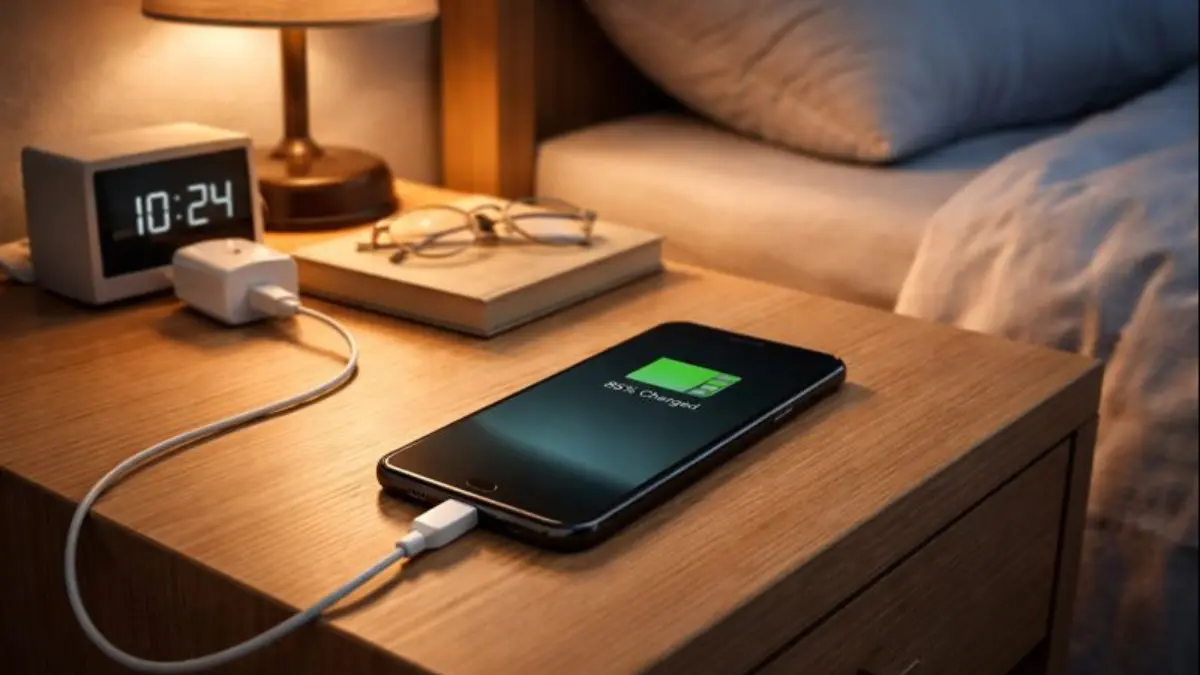
In the current digital age, smartphones have become such a part of our lives that daily tasks cannot be imagined without them. Communication, office work, online shopping, entertainment, and banking—everything is now mobile-dependent. And there is a habit closely linked to this mobile use—sleeping with the phone charged at night.
Many people go to sleep peacefully by charging it at night after using it all day, so that they don’t have to worry about the battery when they wake up in the morning. But the question is—is this habit really safe? Is it harmful to our health, or is it just an unnecessary fear? In this article, we will analyze scientific data, real events, and technical aspects to find out the health, safety, and real impact of sleeping with the phone charged at night on the phone battery. But very few people know how batteries work. Moreover, battery technology is constantly changing. As a result, we have many misconceptions about batteries. Today’s discussion is about such misconceptions. See how many of them you knew.
Why is the habit of sleeping with your phone charged at night so common?
You may have heard that it is not good to always charge your phone to 100 percent. This damages the battery. If you sleep with your phone charged at night, your phone is charged to 100 percent. So it is better not to sleep with your phone or laptop charged at night. This idea was once true. But now technology has changed. With the technology currently used in mobile phone batteries, there is no problem even if you charge your phone all night, because the software will do the work for you.
Let me explain the matter in a little more detail. It is true that there is no problem even if you charge your phone all night. However, this does not mean that there is no problem even if it is charged to 100 percent. Currently, there is software in phones and laptops that does not charge the battery more than 80 percent. That is, even if you sleep with your phone charged, the phone will not charge more than 80 percent. This feature is called Optimized Battery Charging on iPhone and Adaptive Battery on Android devices. If this feature is enabled, you can sleep with your phone charged at night without any worries.
There are some practical reasons behind this habit—
Time saving: Many people do not have the time or opportunity to charge their phones during the day.
- Battery assurance: 100% charge is available before leaving in the morning.
- Fast charge technology: People are becoming more dependent on modern phones because they charge quickly.
- Auto cut-off concept: Many people think that when the phone is 100%, it stops charging on its own, so there is no risk.
- Because of these advantages, people often ignore the risk aspect.
Health aspects: Is sleeping with your phone charging at night harmful to the body?
According to smartphone safety guidelines published by leading manufacturers like Apple and Samsung, users should avoid charging phones on soft surfaces such as beds or pillows to reduce overheating risks.
Samsung battery safety guideline
1. The reality about radiation
Many people think that it is better to discharge the battery completely before charging it. That is, it is better to charge it again when the battery is completely discharged. The history of this idea is very old. Nickel-cadmium batteries were popular in the 20th century. At some point in their lifetime, the story of the ‘memory effect’ spread around. The common belief was that charging the battery before it is completely discharged would reduce the battery’s charge capacity over time. However, this was not entirely true.
One of the most common fears is that a phone that is charging emits harmful radiation. In reality, the radiation emitted by a smartphone is within international standards. There is no solid scientific evidence that the phone emits excess radiation while charging.
However, the problem arises when the phone is kept too close to the head or under the pillow for a long time. Although there is no direct evidence of harm, it can cause discomfort or sleep disturbance in the long term.
2. Loss of sleep quality
We usually keep our phones close to our fingertips while we sleep, charging them. This results in:
- Notification lights
- Vibrations
- Calls or notifications in the middle of the night
These things reduce the depth of sleep. Regular sleep disruption can lead to problems like stress, fatigue, and decreased attention span.
3. Psychological dependence and anxiety
Another negative aspect of keeping your phone charging at night is psychological dependence. The tendency to repeatedly check your phone can increase anxiety before sleep, which can affect your mental health in the long run.
Security risks: This is where the biggest danger lies
1. Overheating
It is normal for a phone to get a little warm while charging. But if—
- The charger is of poor quality
- The battery is old or damaged
- The phone is placed on a pillow, blanket, or bed
Then the heat from the phone cannot escape. This can cause overheating and a risk of fire.
2. Real-life examples of fires
There have been many incidents in different countries around the world where phones have caught fire while sleeping while charging at night. Charging phones under the pillow or on the mattress is especially dangerous.
3. Short circuit and electrical hazards
Using a low-quality charger or extension board can cause a short circuit. Such accidents while sleeping can be fatal.
Long-term effects on batteries
How do lithium-ion batteries work?
Modern smartphones use lithium-ion or lithium-polymer batteries. These batteries reduce power consumption when they are 100% charged, but they do not completely shut down.
Why can overnight charging be harmful?
Leaving the battery at 100% charge for a long time increases chemical stress on the battery
- Battery charge cycles end quickly
- Battery health can decline significantly within a year or two
- As a result, the phone discharges quickly and the battery needs to be replaced.
Has technology been able to reduce risk?
Modern smartphones have added some safety features, such as:
- Overcharge protection
- Temperature control
- Optimized charging (especially on newer phones)
However, these do not completely eliminate the risk, especially if the user is careless.
The correct rules for safely charging your phone at night
If you want to charge your phone overnight, then follow these rules:
✔️ Keep the phone on a hard and flat surface
✔️ Do not place it on pillows, blankets, or beds
✔️ Use original or certified chargers
✔️ Keep the phone at least 3–4 feet away from your head
✔️ Avoid charging when the room is too hot
✔️ If possible, unplug it once it is 80–90% charged
So, when is the best time?
According to experts, it is safest to charge your phone in the daytime, keeping it in sight. This allows you to take immediate action if there is overheating or any other problem.
Common misconceptions vs. real truths
Myth: There is no risk if the phone is 100% charged
Truth: The risk depends on the quality of the battery and charger
Misconception: Leaving the phone on charge causes cancer
Truth: There is no reliable scientific evidence for this
Misconception: All chargers are equally safe
Truth: Low-quality chargers are the biggest risk factor
Conclusion
Although sleeping with your phone charged at night is not directly harmful to your health, it can be a risky habit in terms of safety and battery. Awareness and proper use can greatly reduce this risk. So, along with convenience, give importance to safety. A small precaution can save you from a big accident.
Disclaimer:
This article is written for general awareness and informational purposes only, based on publicly available technology guidelines and consumer safety information. It is not intended as professional medical or technical advice.
Frequently Asked Questions
Question: Can a phone explode if you charge it at night?
Answer: The chances are very low if you have an original charger and a good battery, but the risk is not zero.
Question: Is there a risk of cancer if you sleep with your phone on charge?
Answer: There is currently no reliable scientific evidence on this.
Question: What is the safest practice for charging a phone?
Answer: It is safest to charge it during the day, in a sturdy place, and using the original charger.
About the Author
Amal Ghosal is a digital marketing professional and tech content researcher with experience in writing consumer-focused technology and safety awareness articles. He focuses on explaining complex tech topics in a simple and practical way for everyday users.