
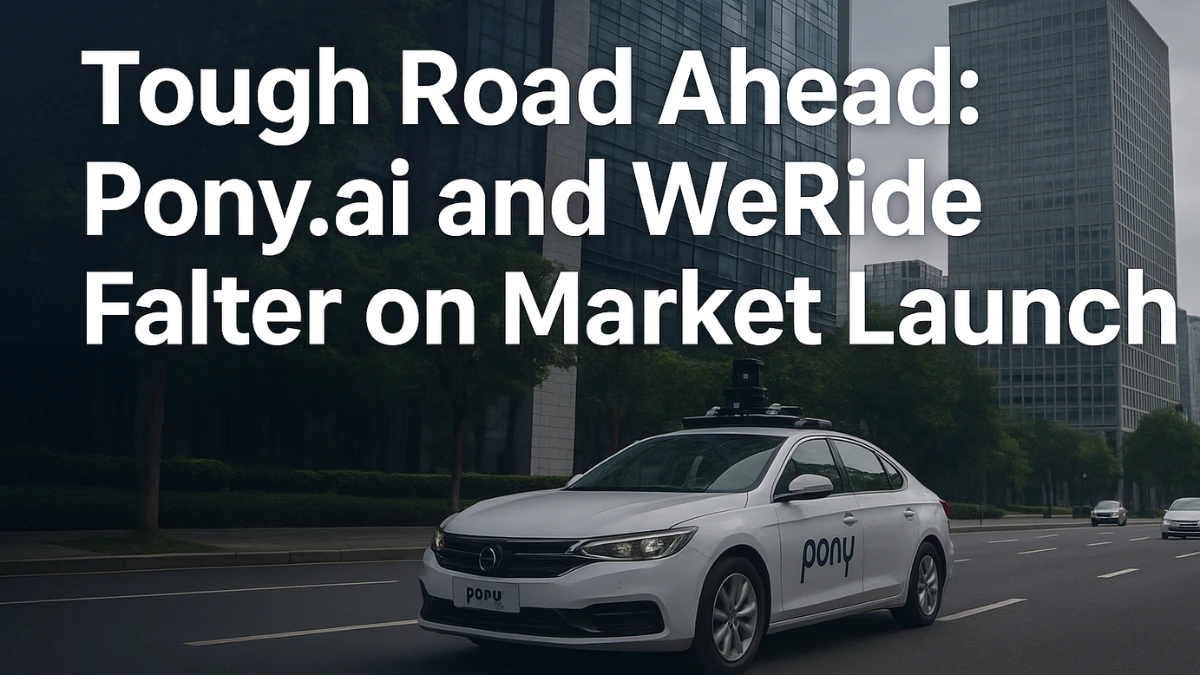
The autonomous vehicle industry has been one of the most closely watched sectors in modern technology, promising a future of safer, smarter, and more efficient transportation. However, recent developments have highlighted the challenges that even the most promising companies face. significant challenges: Pony.ai and WeRide Falter on Market Launch highlights the uncertainty currently surrounding two of China’s leading self-driving startups.
Despite years of investment, research, and pilot projects, both Pony.ai and WeRide are struggling to make a smooth transition from development to large-scale commercial deployment. This article examines into the reasons behind their setbacks, exploring the technology, regulatory hurdles, and market realities that have made their journey more complicated than expected.
This analysis is based on recent market activity, public regulatory announcements in China, and reporting around autonomous vehicle commercialization challenges faced by multiple self-driving startups.
Understanding the Basics
Before diving into the core issues, it’s important to understand the basics of autonomous vehicle technology and why Pony.ai and WeRide became such prominent names.
Autonomous vehicles rely on advanced systems combining artificial intelligence, sensors, cameras, LiDAR, and real-time mapping to navigate roads without human intervention. Companies like Pony.ai and WeRide have been among the front-runners in China’s self-driving race, often compared to U.S. giants like Waymo and Cruise.
Founded in 2016, Pony.ai gained attention for its cutting-edge AI algorithms and partnerships with major automakers. WeRide, founded in 2017, focused heavily on robotaxi and autonomous bus services, testing fleets across several Chinese cities.
Main Content: Why Pony.ai and WeRide Are Struggling
1. Regulatory Uncertainty
One of the biggest hurdles for both Pony.ai and WeRide has been regulatory approval. While China has made significant strides in supporting AI innovation, government oversight on safety standards remains extremely strict.
Each city in China sets its own guidelines for autonomous driving tests and public rollouts. This patchwork of rules creates delays and additional costs. For instance, both Pony.ai and WeRide have had limited permissions for driverless taxi services, meaning they still require safety drivers in many zones.
2. Technical Challenges
Despite years of R&D, achieving Level 4 or Level 5 autonomy—where vehicles operate entirely without human control—remains technically demanding. The AI systems still struggle with unpredictable human behaviors, poor weather conditions, and complex urban environments.
Even minor sensor malfunctions can lead to major safety issues, and both Pony.ai and WeRide have faced publicized incidents that slowed their approvals. The gap between a successful pilot test and mass-market reliability remains wide.
3. Financial Pressure
Autonomous vehicle development is incredibly expensive. Each year, both companies burn through hundreds of millions of dollars in research, testing, and maintenance costs. Investors are now demanding clear timelines for profitability.
However, without full regulatory clearance, scaling operations to generate consistent revenue is nearly impossible. The result? Tight budgets, slower growth, and, in some cases, layoffs or reduced test fleets.
4. Competitive Landscape
China’s self-driving market is crowded. Tech giants like Baidu (Apollo Go) and Huawei are also pouring resources into autonomous driving. These established players have deeper partnerships with local governments, giving them an edge in deployment and public acceptance.
As significant challenges: Pony.ai and WeRide Falter on Market Launch illustrates, the competition has made it harder for both startups to secure exclusive testing zones or funding partnerships.
Method: The Path They Took
Both Pony.ai and WeRide followed similar strategic methods to reach market readiness:
- Testing in Controlled Environments—Initial testing was done in closed or semi-closed urban areas to fine-tune sensors and algorithms.
- Partnerships with Automakers—Collaborations with Toyota, GAC, and Renault-Nissan provided vehicles and hardware integration.
- Robotaxi Services—Both launched limited robotaxi trials in Guangzhou and Beijing, offering rides to the public.
- Data-Driven AI Training—Billions of kilometers of driving data were collected to train their AI models for decision-making.
- Gradual Market Expansion—Plans were made to move from small-scale pilot programs to citywide operations.
However, despite following this structured method, real-world deployment brought unexpected complications that these strategies couldn’t fully address.
Benefits of Autonomous Vehicle Technology
Even though significant challenges, Pony.ai and WeRide are faltering on market launch, reflecting setbacks, it’s important to acknowledge the broader benefits that self-driving technology can bring once these challenges are overcome.
- Increased Road Safety—With human error responsible for over 90% of road accidents, AI-driven vehicles can significantly reduce crashes.
- Traffic Efficiency—Autonomous vehicles can communicate with each other, optimizing traffic flow and reducing congestion.
- Energy Savings—Self-driving EVs can improve fuel efficiency and lower carbon emissions through optimized driving patterns.
- Accessibility—Elderly and disabled individuals could gain independence through autonomous transport solutions.
Uses of Pony.ai and WeRide’s Technology
Even with current market setbacks, the technologies developed by these companies have various potential uses:
- Robotaxi Fleets: Providing urban transport without human drivers.
- Autonomous Buses: Reducing operational costs in public transport.
- Logistics and Delivery: Automating goods movement within cities or industrial parks.
- Smart City Integration: Linking vehicles with infrastructure for real-time data sharing.
- Vehicle Safety Systems: Incorporating AI safety features into traditional cars.
Their innovations continue to influence the broader mobility ecosystem, ensuring that their work remains valuable even amid challenges.
While the long-term benefits of autonomous vehicles remain widely recognized, the current market reality shows a clear gap between pilot success and scalable deployment. Industry analysts consistently point to regulation, unit economics, and operational reliability as the main barriers to commercialization.
Frequently Asked Questions (FAQ)
Q1: What does “significant challenges: Pony.ai and WeRide Falter on Market Launch” refer to?
It refers to the recent struggles faced by autonomous driving startups Pony.ai and WeRide as they attempt to transition from pilot testing to full market deployment.
Q2: Why are Pony.ai and WeRide facing challenges?
They are dealing with regulatory uncertainty, high costs, technical difficulties, and tough competition from larger Chinese tech companies.
Q3: Are these companies still operational?
Yes. Both are still active and continue to develop autonomous technologies, but their market launches have been delayed.
Q4: What’s the biggest obstacle to launching self-driving cars?
Achieving safety and reliability in unpredictable urban environments remains the most significant challenge.
Q5: What’s the future of autonomous driving in China?
The future is still promising. With government support and rapid AI advancements, full commercialization could occur within the next decade.
Editorial Note:
This article draws on publicly available company disclosures, regulatory developments in China’s autonomous driving sector, and broader industry analysis of self-driving commercialization.
significant challenges: Pony.ai and WeRide Falter on Market Launch underscores a critical moment in the evolution of autonomous driving where ambition meets reality. While both companies have pioneered impressive technologies, their struggles highlight the immense complexity of bringing self-driving vehicles to the masses.
Yet, this doesn’t mark failure—it marks progress through challenge. Each obstacle brings valuable lessons that will guide the next wave of AI-powered mobility.
As technology matures, regulations adapt, and infrastructure improves, Pony.ai and WeRide may yet achieve their vision of fully autonomous, safe, and efficient transportation. For now, their journey serves as a reminder that the road to the future of mobility, while promising, remains a significant challenge indeed.
About the Author:
Amal Ghosal is a digital publisher who covers emerging technology, AI-driven mobility, and global market trends in transportation and automation.
1 thought on “Tough Road Ahead: Pony.ai and WeRide Falter on Market Launch”