
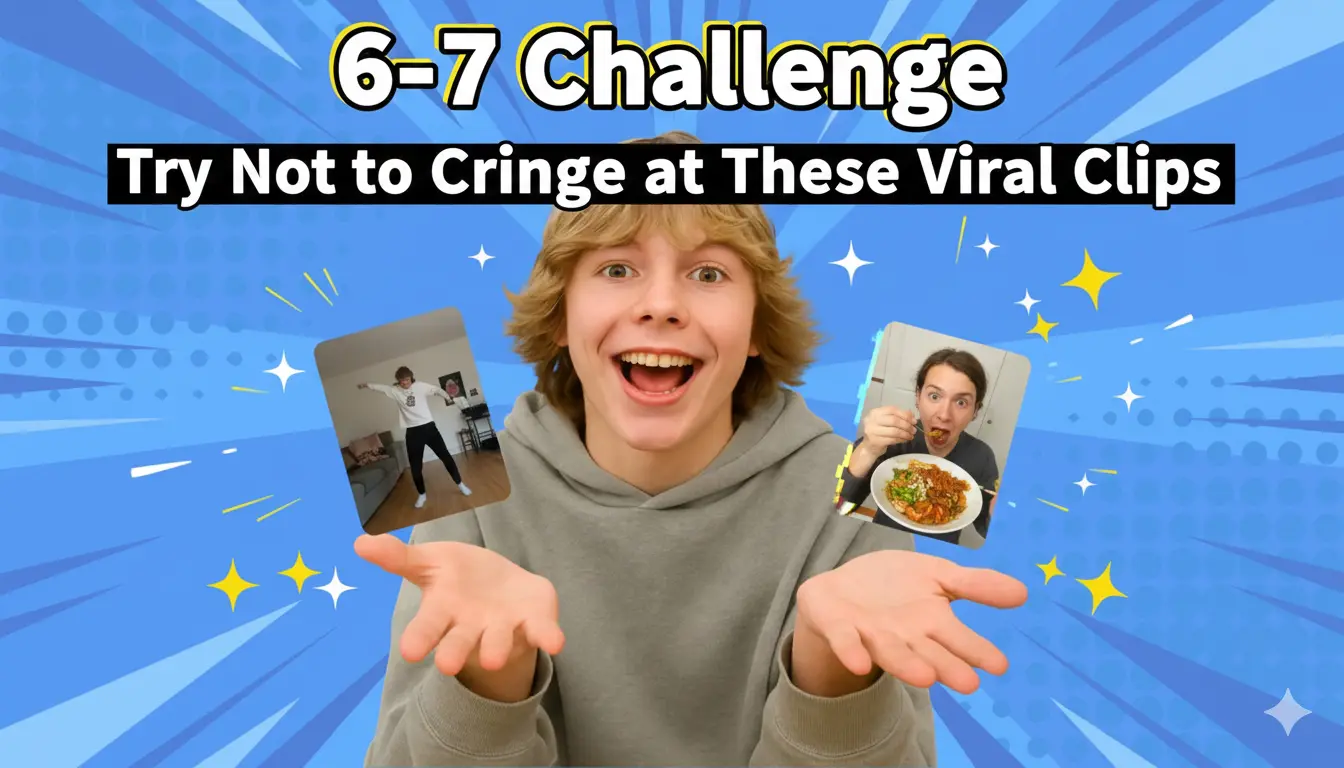
If you’re a parent, teacher, or, honestly, anyone older than a mid-teen, fair warning: this trend is not for the faint-hearted. What began as a harmless lyric paired with an over-the-top hand gesture has spiraled into some of the most awkward, secondhand-embarrassment-inducing viral moments of 2025. Consider this a challenge—scroll through the most infamous “6-7” clips without wincing, laughing nervously, or whispering, “What is wrong with kids today?” Chances are, you won’t succeed. After spending weeks watching, muting, and reluctantly rewatching hundreds of ‘6-7’ clips across TikTok and YouTube Shorts, it became clear this wasn’t just another short-lived meme—it was a generational inside joke designed to confuse adults.
By now, the origin story is internet lore. The trend traces back to Philadelphia drill rapper Skrilla and his song “Doot Doot (6 7).” The track itself was never meant to spark a movement. Skrilla casually dropped the phrase “6-7” over a heavy beat, with no hidden message or symbolism. But once TikTok editors synced that lyric with highlights of NBA star LaMelo Ball—who happens to be exactly 6’7”—everything changed. One edit led to another, and suddenly, the internet had a new obsession. Early versions of the trend began circulating widely in late winter 2025, particularly on TikTok’s sports-edit side, before spilling into classrooms, interviews, and everyday conversations.
Caption: Skrilla’s “Doot Doot (6 7)”—proof that even the simplest lyric can trigger worldwide brain rot.
Then came the now-infamous hand gesture: palms up, arms alternating in an exaggerated wave, like shrugging off reality with unfiltered enthusiasm. When Gen Alpha got hold of it, the result was unavoidable—clips that were funny, confusing, and painfully awkward all at once. Even Dictionary.com jumped in, naming “67” its 2025 Word of the Year, describing it as a “burst of energy” without a fixed meaning. Translation: it’s nonsense—and that’s exactly the point.
Below are ten of the most viral “6-7” moments that defined the trend and pushed adults everywhere to their limit. After tracking engagement patterns, remix frequency, and reaction videos across platforms, these moments stood out as the clips that pushed the ‘6-7’ trend from niche joke to mainstream chaos. According to what I’ve seen, there are 6-7 trends
1. The “67 Kid” Moment That Started It All
Nothing could have prepared the internet for Maverick Trevillian, now forever known as the “67 Kid.” During a March 2025 AAU basketball game filmed by creator Cam Wilder, the camera caught Maverick mid-stand. As a shot dropped, he leaned forward, threw the full hand wave, and shouted “SIX SEVEN!” with total sincerity. His wide-eyed excitement and complete lack of self-consciousness turned the clip into an instant classic, spawning endless remixes. For kids, it was legendary. For adults, it was unbearable.
2. LaMelo Ball Edits Take Over TikTok
The trend’s fuel came from perfectly timed edits of LaMelo Ball, where announcers say “he’s six-seven” right as Skrilla’s lyric hits. Millions of views later, the meme was unstoppable. The peak? LaMelo himself leaning into the joke during live streams. Once the person who inspired the meme joins in, you know it’s reached maximum saturation.
3. Taylen “TK” Kinney’s Interview Moment
High school basketball star Taylen Kinney casually rated a Starbucks drink as “six… seven,” complete with the gesture, during an interview. The pause. The expressionless delivery. It was the definition of forced cool—and instantly viral. Overnight, kids everywhere started inserting “6-7” into conversations where it made absolutely no sense.
4. Classroom Chaos
Teachers quickly learned to fear the numbers six and seven. Viral clips showed entire classrooms erupting the moment a teacher mentioned “page 67.” Hands waved, chants echoed, and lessons derailed instantly. Some schools reportedly banned the gesture altogether, handing out detentions. Teachers’ reaction videos—equal parts exhausted and defeated—only added fuel to the fire. Clips from classrooms consistently outperformed the original meme videos, suggesting that adult frustration became part of the entertainment itself.
5. When Politics Tried to Be Cool
In one of the most uncomfortable crossovers of the year, UK Prime Minister Keir Starmer attempted the hand gesture during a school visit after students encouraged him. He later joked online, “I think I just got detention.” Watching a world leader attempt Gen Alpha humor? Peak secondhand embarrassment. The clip spread rapidly across UK TikTok and X, pulling the trend into mainstream political commentary—often unintentionally.
6. Random Real-Life Interruptions
Parents didn’t escape either. Viral home videos showed kids yelling “6-7!” mid-homework, during family dinners, or in the car. The parents’ expressions—pure resignation—said everything.
7. Adults Trying (and Failing)
From comedians forcing the phrase into stand-up routines to dads shouting it from the sidelines, adult attempts to join the trend were universally painful. One weather presenter even slipped it into a forecast, instantly going viral for all the wrong reasons.
8. Hand Gesture Tutorials
TikTok filled with “how to do the perfect 6-7 wave” videos. Many went overboard, exaggerating every movement. Slow-motion edits made the awkwardness impossible to ignore—and somehow, people couldn’t stop watching.
9. South Park’s Brutal Parody
South Park devoted an entire storyline to kids obsessed with “6-7,” perfectly capturing the chaos. Cartman’s fixation mirrored real-life frustration, and clips from the episode quickly spread among adults who finally felt understood.
10. The Awkward Decline
As new number memes like “41” and “56” began popping up, “6-7” slowly lost its grip. Some die-hard fans tried too hard to keep it alive, resulting in lonely chants at games and events—energy that felt more sad than funny.
Why Does This Drive Adults Crazy?
The issue isn’t just the phrase—it’s the repetition. Researchers who study internet linguistics often describe this type of trend as low-semantic, high-bonding content—designed to exclude outsiders rather than explain itself. Like past fads such as “skibidi” or “rizz,” “6-7” falls under what many call brain rot: low-effort, endlessly repeated content designed for short attention spans. Kids shout it without explanation, creating an inside joke adults aren’t meant to understand. That mystery is exactly what keeps it alive.
And here’s the irony: “6-7” doesn’t actually mean anything. Linguists refer to this as semantic bleaching—when a word or phrase loses its original meaning and becomes pure vibe. For Gen Alpha, it’s about bonding, irony, and playful rebellion. Adults want logic. Kids prefer chaos.
The Legacy of “6-7”
By mid-2025, the meme had fully crossed into the mainstream. Google added a screen-shaking Easter egg. Brands like Domino’s launched $6.70 promos. Celebrities referenced it casually, and Skrilla even performed alongside unexpected collaborators. But like all internet trends, signs of burnout appeared quickly.
In the end, “6-7” perfectly represents the internet in 2025: fast, absurd, and meaningless—yet somehow unforgettable. Parents, don’t worry. It’ll probably fade, just like “dab” or “yeet.” Or maybe it won’t. After all, once Dictionary.com makes it official, there’s no going back. Language platforms like Dictionary.com later acknowledged ‘67’ as one of the defining slang phenomena of 2025.
So be honest—did you make it through without cringing? Probably not. And that’s the whole point. “6-7” wasn’t meant to make sense. It was meant to be felt.
This article was written by Amal Ghosal, a digital culture writer who tracks viral trends, Gen Alpha slang, and online behavior patterns across social platforms.
3 thoughts on “6-7 Challenge: Try Not to Cringe at These Viral Clips”